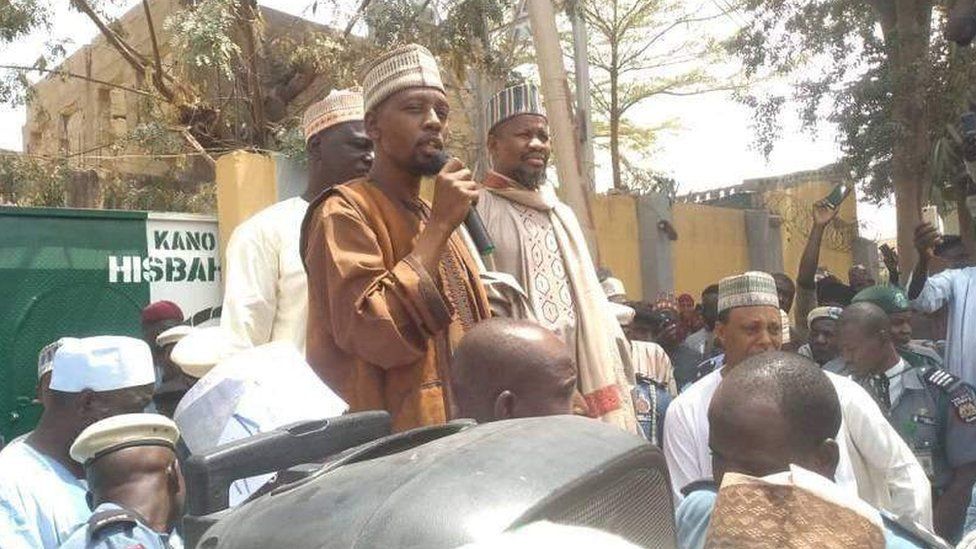
A musician in Nigeria's northern state of has been sentenced to death by hanging for blaspheming

Protesters
Image captionProtesters had called for action against the musician

A musician in Nigeria's northern state of  has been sentenced to death by hanging for blaspheming against the Prophet Muhammad.

An upper Sharia court in the Hausawa Filin Hockey area of the state said Yahaya Sharif-Aminu, 22, was guilty of committing blasphemy for a song he circulated via WhatsApp in March.

Mr Sharif-Aminu did not deny the charges.

Judge Khadi Aliyu Muhammad Kani said he could appeal against the verdict.

States across Muslim-majority northern Nigeria use both secular law and Sharia law, which does not apply to non-Muslims.

Only one of the death sentences passed by Nigeria's Sharia courts has been carried out since they were reintroduced in 1999.


The singer who is currently in detention, had gone into hiding after he composed the song.

Protesters had burnt down his family home and gathered outside the headquarters of the Islamic police, known as the Hisbah, demanding action against him.
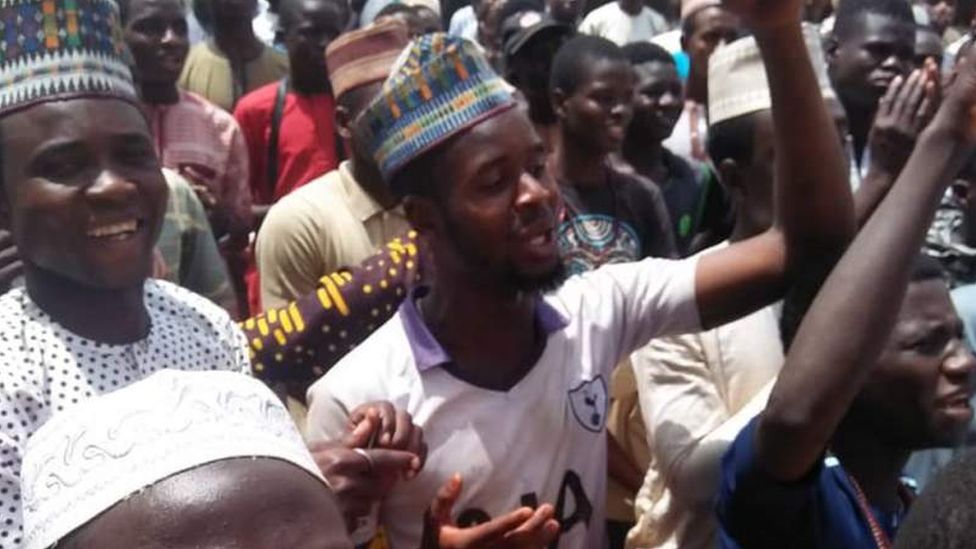
Image copyrightIDRIS IBRAHIMProtesters
Image captionThe Islamic police had appealed for people not to take the law in to their own hands after the song was released

Critics said the song was blasphemous as it praised an imam from the Tijaniya Muslim brotherhood to the extent it elevated him above the Prophet Muhammad.

'Judgement will serve as deterrent to others'

The leader of the protesters that called for the musician's arrest in March, Idris Ibrahim, told the BBC that the judgement will serve as a warning to others "contemplating toeing Yahaya's path"."When I heard about the judgment I was so happy because it showed our protest wasn't in vain.

"This [judgement] will serve as a deterrent to others who feel they could insult our religion or prophet and go scot-free," he said.

Who is Yahaya Sharif-Aminu?

Few people had heard of him before his arrest in March.

An Islamic gospel musician, he is not well-known in northern Nigeria and his songs were not popular outside his Tjjaniya sect, who have many such musicians within their ranks.

How common are death sentences in Sharia courts?

Several sentences have been passed, including for women convicted of having extramarital sex - cases which have caused widespread condemnation.


The last time a Nigerian Sharia court passed a death sentence was in 2016 when Abdulazeez Inyass, was sentenced to death for blaspheming against Islam during after a secret trial in Kano.

He was alleged to have said that Sheikh Ibrahim Niasse, the Senegalese founder of the Tijaniya sect, which has a large following across West Africa, "was bigger than Prophet Muhammad".

The sentence has not been carried out as a death penalty in Nigeria requires the sign-off of the state governor.

Mr Inyass is still in detention.

line

How Nigeria's Sharia courts work

By Mansur Abubakar, BBC News, Kano

Twelve states in Nigeria's Muslim-dominated north operate the Sharia system of justice, but only Muslims can be tried in its courts.

The Sharia system, which also has its own Court of Appeal, handles both civil and criminal matters involving Muslims and its judgements can also be challenged in Nigeria's secular Courts of Appeal and the Supreme Court.

The Sharia judges, known as alkalis, are learned in both Islamic and secular laws.

If a case involves a Muslim and a non-Muslim, the non-Muslim has the option of choosing where they want the case to be tried. The Sharia court can only hear the case if the non-Muslim gives written consent.

Sentences handed down by the courts include floggings, amputations and the death penalty.

line

Comments

Popular posts from this blog

How to Rebuild Your Confidence After Failure by Kneelyo Akinbowale

How to Rebuild Your Confidence After Failure by Kneelyo Akinbowale  Failure has a way of shaking the very foundation of our confidence. One moment, you believe in yourself; the next, doubt creeps in, whispering that you are not good enough, not smart enough, or not destined to succeed. But here is the truth many people never tell you: failure does not destroy confidence—how you interpret failure does. If you have failed recently, this is not the end of your story. It is the beginning of a wiser, stronger chapter. Understand That Failure Is Not Your Identity One of the most dangerous mistakes people make after failing is allowing the failure to define who they are. You didn’t fail because you are a failure. You failed because you tried. Every successful person you admire today has failed in one way or another. The difference is that they refused to turn a moment into a permanent label. Separate what happened from who you are. Your worth is not measured by one outcome. Al...

Growth Is Painful, But Stagnation Is Worse by Kneelyo Akinbowale

Growth is not a comfortable journey. It stretches you, challenges your beliefs, exposes your weaknesses, and forces you to confront versions of yourself you would rather ignore. Many people avoid growth not because they don’t desire progress, but because they fear the pain that often comes with it. But here is the truth many don’t like to face: while growth is painful, stagnation is far more dangerous. The Pain That Comes With Growth Growth demands change, and change rarely feels good at first. It may require you to leave familiar environments, let go of relationships that no longer serve your purpose, or unlearn habits that once kept you comfortable but now keep you stuck. Pain in growth shows up as: • Fear of the unknown • Temporary failure and embarrassment • Discipline over comfort • Sacrificing immediate pleasure for long- term fulfillment. This pain, however, has a purpose. It is the pain of becoming—of building strength, wisdom, and character. Just like muscles grow...

Growth Mindset vs Fixed Mindset: The Battle That Shapes Your Future by Kneelyo Akinbowale.

In life, success is not controlled by talent alone, background, or even opportunity. More often than not, it is controlled by how we think. The mindset you adopt determines how you respond to challenges, failure, criticism, and growth. Two dominant mindsets shape human behavior: the Fixed Mindset and the Growth Mindset. Understanding the difference between these two can change the direction of your life. What Is a Fixed Mindset? A fixed mindset is the belief that intelligence, talent, and abilities are permanent traits. People with this mindset believe they are either “good at something” or “not good at it,” and nothing can change that. Characteristics of a Fixed Mindset: • Fear of failure • Avoiding challenges • Giving up easily • Feeling threatened by other people’s   success • Taking criticism personally • Believing talent alone leads to success Someone with a fixed mindset might say: •“This is just who I am.” •“I’m not smart enough for that.” •“I’ve tried befor...